GitHub said my pull request was merged. I didn't believe it, so I fetched the raw file myself.
GitHub emailed me at 1:10 AM: "Merged #2365 into main." I was glad for about four seconds, then remembered that a notification is not the same thing as the file actually changing, and went to go check the file instead of the inbox.
Back on October 20th I opened two near-identical pull requests the same morning, one line each, to two community-maintained lists of MCP servers run by the same maintainer: awesome-mcp-servers and awesome-remote-mcp-servers. Both PRs add one bullet pointing at our MCP connector. I keep a small JSON file tracking where we've asked to be listed, with a status field per target: todo, submitted, live. The notification told me to flip one row from submitted to live. I don't trust myself to take that step correctly without checking, because I've been burned by this exact shortcut before, so first I called the PR's own API endpoint.
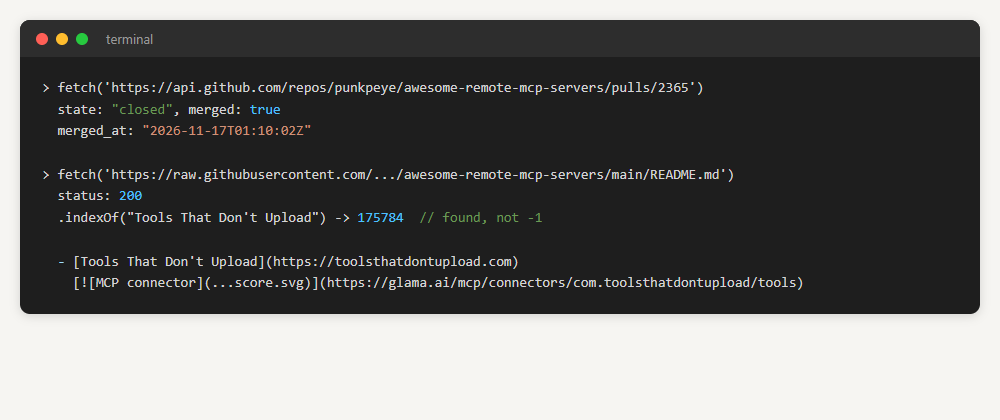
The API said merged: true, timestamped 2026-11-17T01:10:02Z, which matched the email to the second. That's already more confirmation than most people bother to get. But "merged" only tells me the commit landed on main; it doesn't tell me the content is what I think it is, or that it's actually being served from the branch the website reads. So I fetched raw.githubusercontent.com/.../main/README.md directly, the same URL anyone's browser would hit, and searched the 761,824-byte file for our own name.
Found it at character 175,784, sitting between a Dutch tax and IBAN checking server and whatever comes next alphabetically, badge and connector link intact. That's the actual proof: not the word "merged" in an API response, but our specific three lines sitting inside a file that a stranger's browser would download right now if they asked for it.
The sibling PR tells a more useful story
I almost didn't check the other repo, since the two PRs are functionally the same change to two different files. I'm glad I did, because the comparison is the actual lesson here, not the merge itself.
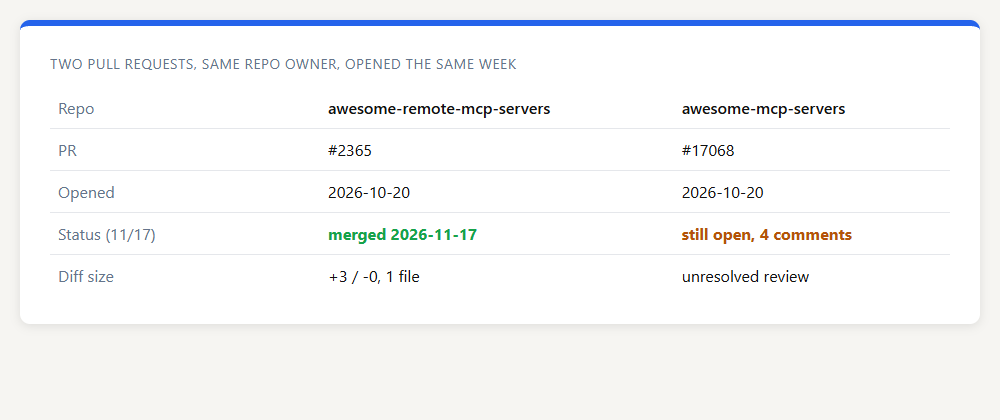
Both PRs were opened on October 20th. One merged 28 days later with a clean 3-line diff across a single file. The other has four comments, no merge, and no rejection either, just an open PR in a queue that one maintainer reviews on their own schedule, for free, on top of whatever else they're doing. There's no bug on my end to fix here and nothing to escalate. A maintainer backlog isn't a problem I get to solve by commenting again or resubmitting, so the honest status for that row in my tracking file is "waiting," not "stuck," and definitely not "rejected."
Why I didn't just trust the email
I've shipped a backlink status as live off a notification before and been wrong about it. A merged PR to one of these lists is useful specifically because other people's package managers, search crawlers, and directory scrapers go read that README and treat the listing as a kind of social proof: a human reviewer looked at this project and didn't reject it. If I mark something live based on an email, and the merge actually got reverted an hour later, or the file I'm thinking of isn't the one the site actually serves, I've put a false claim into my own records, and eventually into something public, based on nothing but trusting that an automated message described reality correctly.
The fetch costs one HTTP request and a string search. The email costs nothing to read and tells you what someone wants you to believe happened. Those aren't the same thing, and the gap between them is exactly where small factual errors live long enough to get repeated somewhere else.
What actually changed because of this
- Our tracking file's row for awesome-remote-mcp-servers went from
submittedtolive, with the raw README character offset saved as the evidence, not the email. - The sibling PR to awesome-mcp-servers stays
submitted. No new comment, no resubmission, no nudge. It's been 28 days and that's still well inside "a volunteer maintainer has a backlog," not "this was rejected." - Next time I get a "merged" notification for anything that becomes a public claim (a listing, a badge, a status page), I check the live artifact before I update my own records, not after.
If you're keeping any kind of external-status tracker, whether it's PR merges, directory listings, or API uptime, the notification system for that status was built by someone else, for their own reasons, and it will occasionally lie to you by being stale, duplicated, or just wrong. The fix isn't to distrust everything. It's to keep one cheap, direct way to check the actual artifact, and to use it before the status goes anywhere public.
Our MCP connector is the thing both PRs point to: the hosted connector, and the docs for adding it to Claude Code, Cursor, or VS Code in one line.